Hair loss (hair fall) and baldness are common problems faced by men and women today. Whether it’s due to genetics, lifestyle, stress, diet, or medical conditions – losing hair can affect not only your looks but also your confidence.In this complete guide, we will explore everything about hair loss and baldness in detail. From how hair grows and what the hair cycle is, to why hair falls, different types of baldness, treatment options, and even the role of diet and nutrition – we will cover it all.Here are 10 key points we will know about in this article.
How hair is formed
“When we are in our mother’s womb and reach about 22 weeks, all the hair follicles of our entire body are already formed. All the hair follicles are created by that time. After birth, no new hair follicles are formed. Whatever develops, develops at that stage only. On the whole head, approximately one million hair follicles are formed.”
“Hair follicles are the points of origin for hair – where the root is present and the hair is held in place.
This is the part that supplies the hair with vitamins, minerals, proteins, and nutrients needed for growth.
It is like a small sac inside the skin, where the entire process of hair growth takes place. This is what we call a hair follicle.
You can also understand it with an example –
Just like a baby kangaroo stays in its mother’s pouch, in the same way, our hair stays inside this follicle (sac) and grows gradually from there.”
What is the hair cycle
“Now let’s understand what our Hair Cycle is.The hair cycle is divided into three parts.
Anagen phase
The first is the Anagen Phase, also called the Growth Phase.In this phase, the length of the hair keeps increasing continuously.For a person, this growth phase can last from 2 years to 8 years.For example, if someone’s anagen phase is 2 years long, their hair will keep growing for 2 years.If someone’s phase is 3 years, their hair will grow for 3 years.So, depending on how many years a person’s anagen phase lasts, that’s how long their hair will continue to grow.After that, the hair stops growing and enters the Catagen Phase.”
Catagen phase
After the Anagen Phase, the hair enters the Catagen Phase, also known as the Transition Phase.
This stage lasts for about 2 weeks. During this time, the hair does not grow any further. The connection that supports the process of hair formation is cut off, which means the hair that has already grown simply remains in place. Finally, this hair moves into the Resting Phase.
This transitional stage is what we call the Catagen Phase.
Telogen Phase
In the Telogen Phase, the hair follicles that were resting during the Catagen Phase become active again to start producing new hair.The new hair, while emerging from beneath, gradually pushes the old resting-phase hair outward.
Because of this natural push, the old resting hairs eventually fall out. This natural falling of hair is called shedding, and it is a normal part of the Telogen Phase.
Natural hair shedding process
Hair shedding is a natural part of the hair growth cycle, through which new hair is formed.Shedding 50 to 100 hairs each day is a normal part of the hair growth cycle. It should not be considered a sign of hair loss or baldness.
This process happens because new hair grows from beneath the scalp, pushing the older hair upwards. As a result, the old hair naturally falls out, making way for new growth.
Shedding is a normal process and a natural part of your body’s life cycle.
What is hair loss & baldness
Hair loss is called alopecia in medical term. If you notice a bald patch on your head, or if your hair looks thinner in certain areas compared to others, or you start feeling that your hair is becoming fine and weak in the early stages – this means you are experiencing hair loss.
Similarly, if you are losing more than 50 hairs a day and fewer new hairs are growing back as part of the natural hair cycle, it indicates that you are suffering from hair loss.
Over time, if this continues and the lost hair is not replaced, it can lead to baldness.
Male vs Female Hair Loss Pattern
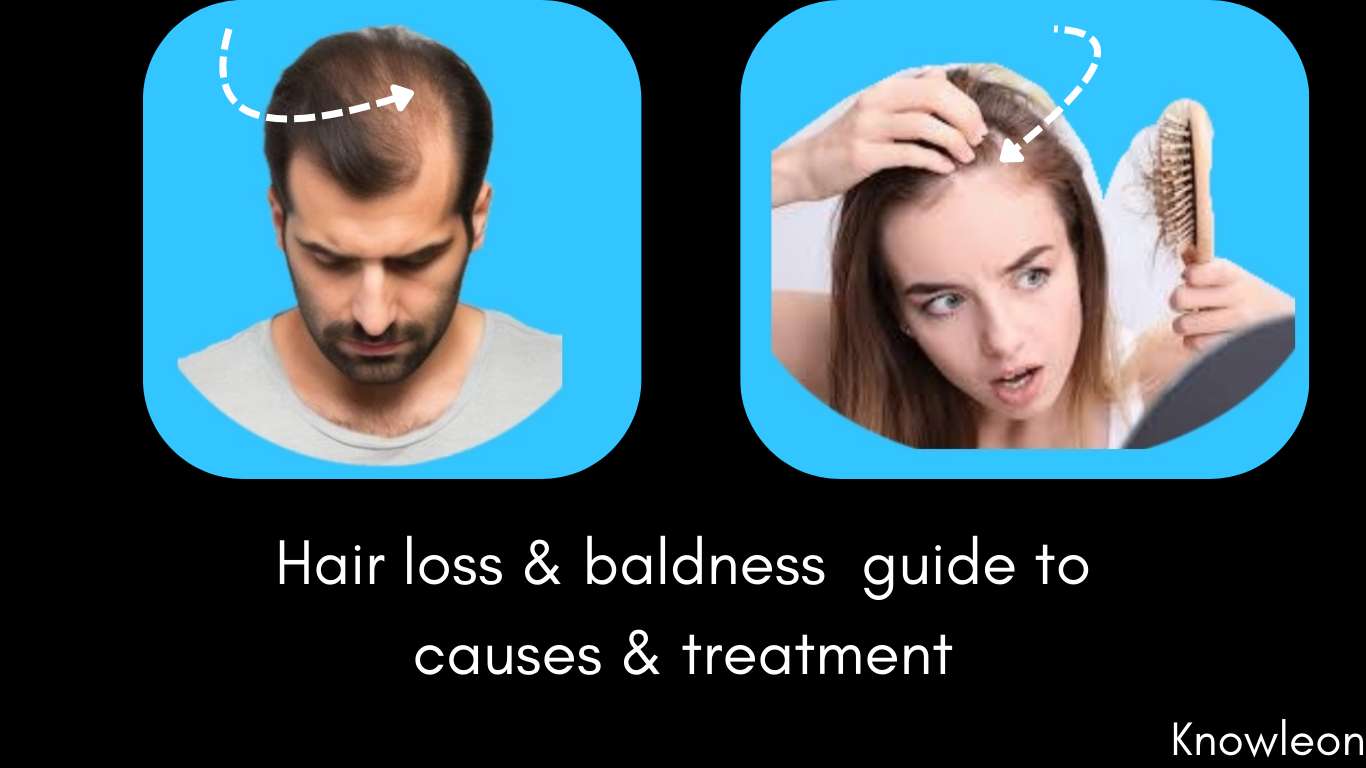
Male Pattern Hair Loss In men, hair loss usually starts from the front hairline and the crown (back of the head). Over time, these areas thin out and join together, creating a ring-like appearance. This is commonly known as Male Pattern Baldness.
Female pattern hair loss In women, hair loss happens more gradually over the years. The hair becomes thin and weak, especially on the top of the head. Unlike men, women usually retain a thin line of hair along the front hairline, even when thinning occurs.
Types of hair loss
“Some types of hair loss are permanent, while others are temporary.”
Telogen Effluvium
Telogen Effluvium is a condition where temporary hair loss occurs due to factors like stress, depression, emotional strain, or sudden hormonal changes in the body.The good thing is that when the root cause is resolved, the hair usually starts growing back naturally.
For example, during pregnancy, women often experience hormonal changes that may trigger rapid hair fall for a certain period of time. However, this type of hair loss does not require any specific treatment, as the hair typically grows back on its own once the body returns to balance.
Androgenic Alopecia
If you have a hereditary problem, meaning hair loss passed down from your parents or ancestors, it can lead to early hair thinning and baldness. This condition is known as Androgenic Alopecia.
It can impact both men and women, although the type of hair loss may vary between them.
Alopecia Areata
Alopecia Areata is an autoimmune disease, which means that your own immune system mistakenly attacks your hair, damaging the hair follicles.
This disorder can develop anywhere on the body or scalp, leading to thinning or loss of hair in those areas.
Anagen Effluvium
In Anagen Effluvium, a person experiences very rapid and excessive hair loss. This type of hair loss often occurs due to the use of certain medications, such as chemotherapy for cancer patients or radiation therapy.
Treatment of Hair Loss
There are two types of treatments for hair loss:
- Medication – Non-surgical treatment options using medicines.
- Surgical Procedures (Hair Transplant) – If medications do not provide effective results, hair transplant becomes the available option.
Medication
Minoxidil medicine
Minoxidil – The drug Minoxidil is used directly on the scalp. It helps by stimulating the scalp and improving blood flow to the follicles beneath. This improved circulation helps support hair regrowth. Minoxidil is an FDA-certified remedy for hair loss.
Finasteride medicine
Finasteride medicine – The enzyme 5-alpha-reductase in our body converts testosterone into DHT (dihydrotestosterone). Hair roots are negatively impact by DHT, which makes the hair gradually thinner.
When you take Finasteride, its molecules inhibit the action of 5-alpha-reductase. As a result, testosterone is not converted into its active form (DHT), helping to reduce hair thinning and slow down hair loss.
Surgical Procedures (Hair Transplant)
If medications are not giving you satisfactory results, you can opt for surgical procedures such as a hair transplant.
Hair Transplant
In a hair transplant, healthy hair follicles are taken from areas of the scalp where hair growth is good and transplanted to areas where hair growth is needed.This procedure is called a hair transplant.
Scalp Reduction
Scalp reduction is a surgical approach used to treat minor bald areas on the scalp. The procedure works by pulling together healthy surrounding hair to minimize the bald region.
Scalp Expansion
Scalp expansion is a surgical technique in which the area of the scalp with good hair growth is gradually stretched and expanded, so that it can be used to cover areas where hair is thinning or missing.
Scalp Flaps
In this procedure, a section of scalp with healthy hair growth is surgically moved and placed onto an area of the scalp where hair is missing.
Diet for Hair Loss
If you are experiencing hair loss, eating the right foods can make a big difference. Certain nutrients help keep your hair healthy, support growth, and reduce hair fall.
- protein – Adequate protein is necessary for strong and healthy hair growth.To meet your protein needs, you can include foods like eggs, fish, chicken, lentils, beans, Greek yogurt, and paneer in your diet.
- iron – Lack of iron in the body may result in hair fall and fragile hair. To maintain healthy iron levels, you can include foods like spinach, red meat, beetroot, lentils, chickpeas, and pumpkin seeds in your diet.
- Zinc & Selenium – Zinc and selenium help prevent dandruff and hair breakage. To get these nutrients, you can include whole grains, nuts, pumpkin seeds, sunflower seeds, and eggs in your diet.
- Omega-3 Fatty Acids – Eating foods rich in omega-3 fatty acids nourishes the scalp and helps reduce inflammation, supporting healthier hair growth.To include them in your diet, you can eat walnuts, flaxseeds, chia seeds, and fatty fish.
- Vitamin D – Insufficient vitamin D can sometimes result in hair shedding.To maintain adequate levels, you can get some sunlight exposure, and include fortified milk, mushrooms, and fatty fish in your diet.
- Vitamin E – Vitamin E increases blood supply to the scalp, encouraging healthy hair development. You can include almonds, avocado, olive oil, and sunflower seeds in your diet to get this nutrient.
- Biotin and Vitamin B12 – To support healthy hair, you can include biotin and vitamin B12-rich foods such as eggs, whole grains, milk, leafy greens, and bananas in your diet.
- Vitamin C – Vitamin C-rich foods like citrus fruits, strawberries, kiwi, bell peppers, and amla help boost collagen production and improve iron absorption, supporting stronger and healthier hair.
Expert Hair Growth Advice
Exercise
The nutrients you consume, such as minerals, vitamins, and proteins, can only be effectively used by your body if your blood circulation is good. To improve blood flow, regular exercise is essential. Activities like leg pump exercises, running, squats, jogging, or skipping help increase blood circulation, ensuring that nutrients reach your hair follicles properly and support healthy hair growth.
Massage
Gently massage your hair and scalp regularly in different areas without causing any damage. Using oil for the massage isn’t mandatory—you can also do a dry massage. However, if your scalp is dry, using oil is recommended. Regular massage helps improve blood circulation to the scalp, supporting healthier hair growth.
Mistakes in Hair Maintenance
Check Your Bathing Water
The water you use for bathing or washing your hair can affect hair health. If the water is hard rather than soft, it can damage your hair by stripping away moisture, affecting texture, and reducing smoothness. Frequent use of hard water can lead to hair breakage within a few days, especially if you also use shampoo regularly.
To prevent this, check the TDS (Total Dissolved Solids) level of your water. For safe bathing, the TDS level should be around 300–400 ppm, while for drinking water, it should be 50–150 ppm. Maintaining these levels helps protect your hair and overall health.
Harmful Substances
Avoid using highly chemical or advanced shampoos that can be harsh on your hair. Choose shampoos that are gentle and do not strip your hair of its natural moisture. Harsh chemicals can weaken hair strands, cause dryness, and make hair prone to breakage over time. Opting for mild, nourishing shampoos helps maintain your hair’s natural texture, shine, and strength while keeping it healthy in the long run.
Heating instrument
Avoid using heating tools like straighteners or curling irons on your hair regularly. Occasional use is fine, but daily use can damage hair. Whenever possible, let your hair air dry instead of using a blow dryer to maintain its natural health and prevent breakage.